How AI-Powered ERP Is Transforming Manufacturing Business Management
Manufacturing companies generate enormous amounts of business data every day. Sales orders, purchase orders, production records, machine activity, quality inspections, inventory movements, maintenance records and customer information are all stored within different ERP modules. The challenge is no longer simply collecting data—it is finding the right information quickly and turning it into useful business insights.
This is where AI-powered ERP is changing the way manufacturing businesses work.
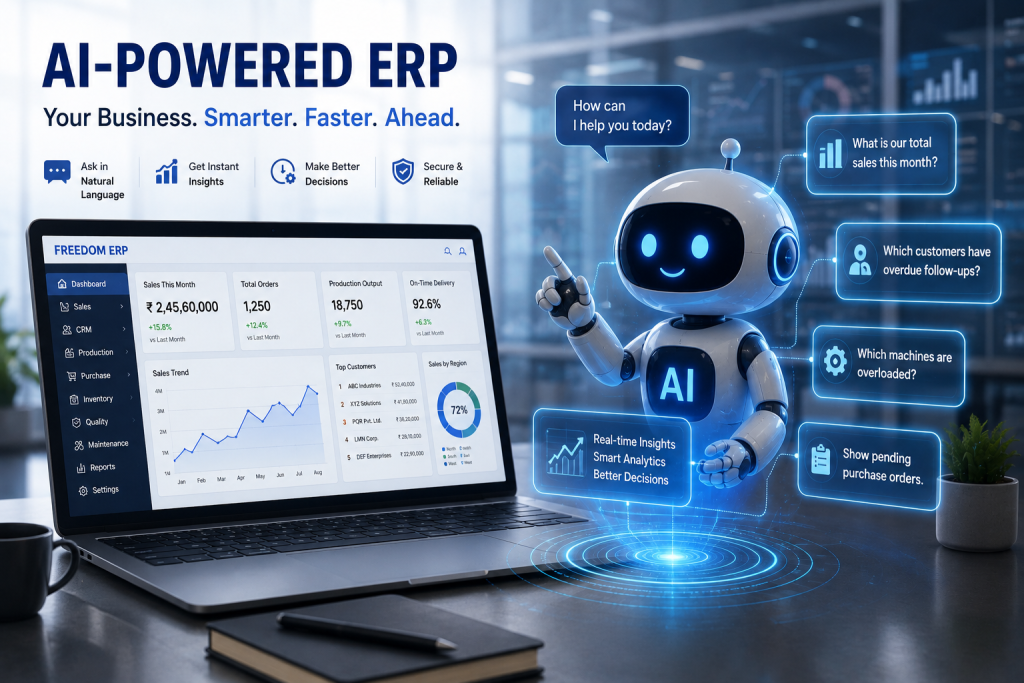
Instead of depending entirely on traditional reports and complicated ERP screens, businesses can use an intelligent assistant to ask questions in everyday language and receive answers based on information already available in their ERP system.
From Searching Reports to Asking Questions
Traditional ERP systems provide detailed reports, but users often need to know the correct report name, screen or module before they can find the required information.
An AI-powered ERP approach simplifies this process.
For example, a manager could ask:
- What were our total sales this month?
- Which customers have overdue follow-ups?
- Which machines are overloaded?
- What was our production rejection percentage?
- Which purchase orders are still pending?
- Which dispatch commitments are overdue?
Freedom AI is designed to understand such business questions and provide answers using information available in Freedom ERP.
This creates a more natural interaction between employees and business data.
AI for Different Manufacturing Departments
One of the biggest advantages of AI-powered ERP is that its usefulness is not limited to a single department.
Sales and CRM Intelligence
Sales managers can use AI to understand sales performance, customer-wise sales, top products, salesperson performance, returns and period-to-period growth.
CRM-related questions can cover active leads, open lead value, overdue follow-ups, quotation status, sales targets and pending sales order quantities.
This helps sales teams spend less time compiling information and more time acting on it.
Production and Planning Intelligence
Manufacturing planners need to continuously monitor work orders, machine capacity, production plans and dispatch schedules.
AI can help answer questions such as:
- Which machines are loaded above capacity?
- Which work orders have not started?
- What was today’s planned versus produced quantity?
- Which dispatch plans are overdue?
Freedom AI’s planning functionality covers work orders, dispatch plans, machine loading, route sheets, production planning and cost estimation.
Production teams can also analyse accepted, rejected and reworked quantities, rejection reasons, machine idle time, production efficiency, material usage and scrap-related information.
Improving Quality Visibility
Quality problems can have a direct impact on manufacturing costs and customer satisfaction.
An AI-enabled ERP can help quality teams review inspection results, acceptance and rejection percentages, rework quantities, rejection reasons, pending approvals, calibration status, customer complaints and corrective actions.
For example, a quality manager can ask:
“What are the major causes of quality rejection?”
or
“Which instruments are overdue for calibration?”
Freedom AI is designed to provide this type of information from quality-related ERP records.
Smarter Purchase and Inventory Decisions
Purchasing and stores departments also generate large amounts of transactional information.
AI can help users review purchase requisitions, supplier quotations, purchase orders, pending quantities, overdue deliveries, supplier-wise purchase values and price-list validity.
Stores teams can similarly analyse inward quantities, inspections, material issues, stock movements, returns, scrap receipts, stock allotments and release quantities.
Instead of manually checking multiple screens, employees can ask targeted questions and focus on the information that requires attention.
Maintenance Intelligence for Better Machine Visibility
Machine downtime can affect production schedules, delivery commitments and overall manufacturing efficiency.
AI-powered ERP can help maintenance teams analyse breakdown counts, downtime, breakdown reasons, root-cause analysis, preventive maintenance status, spare-parts consumption, tool-service requirements and utility consumption.
Questions such as “Which machine had the highest downtime?” can provide management with a faster starting point for investigating operational issues.
The Importance of End-to-End Traceability
Another important capability of AI-powered ERP is the ability to trace a transaction through connected business stages.
For example, a manufacturing order may move through several stages:
Enquiry → Quotation → Sales Order → Work Order → Route Sheet → Production → Inspection → Dispatch → Invoice
Freedom AI can help users trace such connected processes and identify completed stages, pending stages, missing documents and incomplete processes.
This can be particularly valuable when management wants to understand why a particular order is delayed.
AI That Finds What Is Missing
A major advantage of intelligent ERP analytics is that it can highlight gaps rather than simply displaying completed transactions.
For example, the system can identify sales orders without work orders, work orders without route sheets, production records without inspection, purchase orders without inward entries and inward entries without inspection.
This shifts ERP from being merely a record-keeping system toward a tool for identifying business gaps.
Faster Decisions With Existing ERP Data
Manufacturing organisations already have valuable information stored inside their ERP. The challenge is making that information accessible to the people who need it.
Freedom AI is designed to convert existing ERP information into business-friendly answers, helping management obtain information faster, reduce dependency on employees who know where specific reports are located and improve the speed of review meetings.
The Future of Manufacturing ERP
The future of ERP is not necessarily about adding more screens and more reports. It is about making business information easier to access.
With natural-language questions, voice-based interaction, conversational follow-ups and intelligent summaries, AI can make ERP systems more accessible to managers and operational teams. Freedom AI supports voice questions and conversational interactions while maintaining a read-only analytics approach that does not directly modify ERP transactions.
For manufacturing companies, this means business data can become easier to understand, easier to review and faster to act upon.
AI-powered ERP is therefore not simply about adding artificial intelligence to an ERP system. It is about changing how people interact with business information—from searching for reports to simply asking the right questions.