Introduction
In the machining industry, every minute matters.
Machines are the heart of a manufacturing operation. CNC machines, turning machines, milling machines, grinding machines, and other production equipment must operate efficiently to meet production schedules and customer expectations. When a machine suddenly stops, the impact can go far beyond the machine itself.
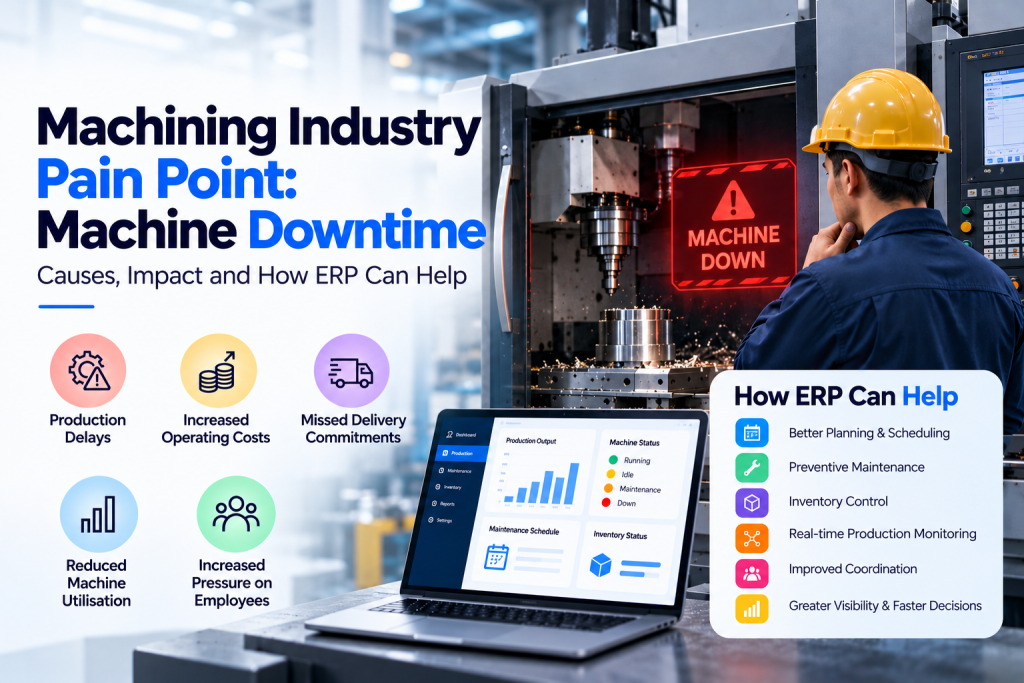
Machine downtime can delay production, increase operating costs, affect delivery schedules, reduce productivity, and ultimately impact customer satisfaction.
For machining companies, reducing downtime is not simply about repairing machines quickly. It requires better planning, preventive maintenance, real-time production monitoring, inventory control, and coordination between different departments.
This is where modern manufacturing technology can make a major difference.
The best ERP software for the manufacturing industry can help machining businesses connect production, maintenance, inventory, purchase, quality, planning, and other operations in one system. Instead of depending on spreadsheets, paper records, phone calls, and disconnected information, manufacturers can gain better visibility and make faster decisions.
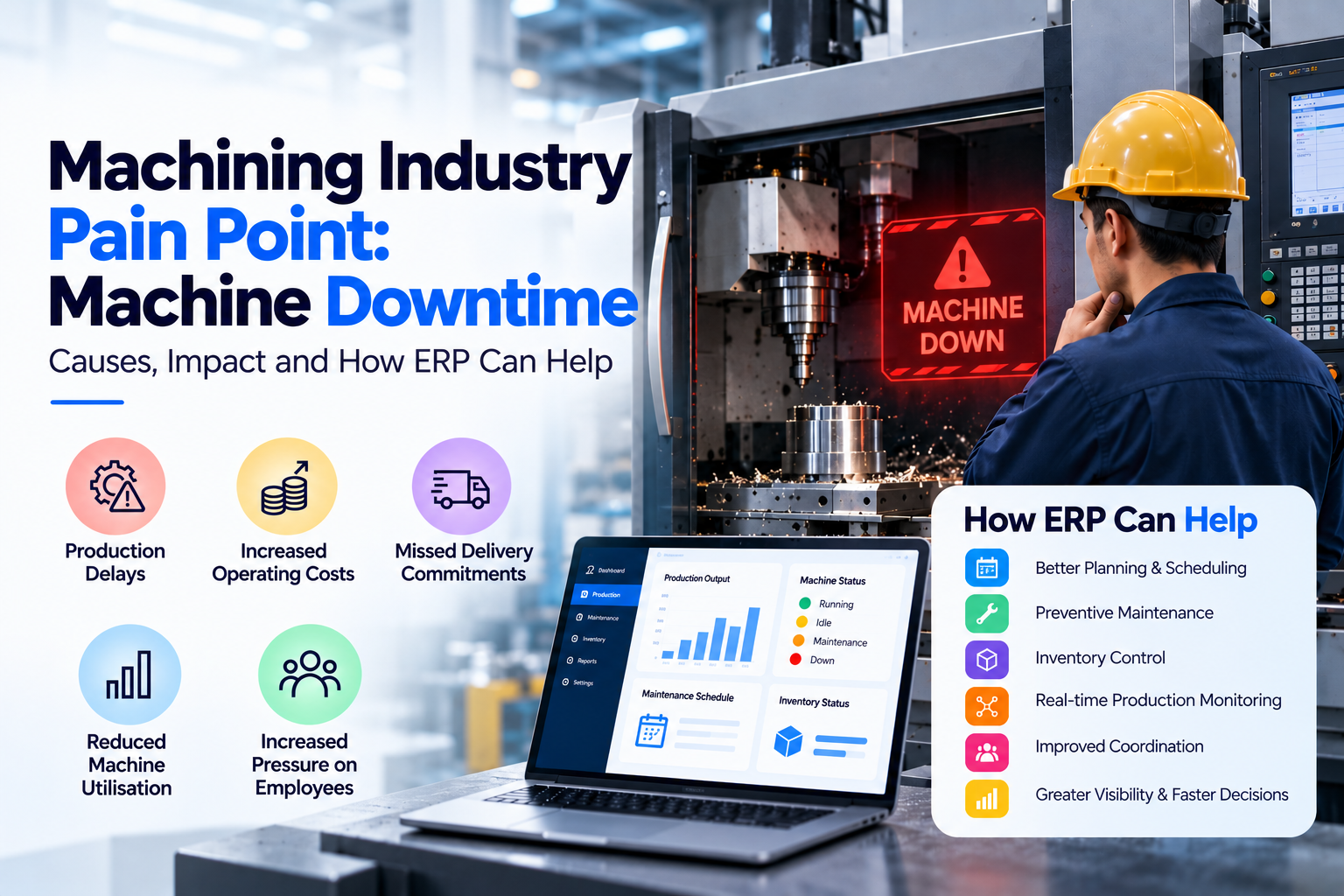
What Is Machine Downtime?
Machine downtime refers to the period when a machine is unavailable for production.
Downtime can happen for many reasons. A machine may stop because of mechanical failure, lack of raw materials, tooling problems, maintenance requirements, operator issues, power interruptions, or production planning mistakes.
There are generally two types of machine downtime:
1. Planned Downtime
Planned downtime is scheduled in advance.
Examples include:
- Preventive maintenance
- Machine servicing
- Tool replacement
- Equipment upgrades
- Scheduled inspections
- Cleaning and calibration
Planned downtime can be managed more effectively because the production team knows when the machine will be unavailable.
2. Unplanned Downtime
Unplanned downtime happens unexpectedly.
Examples include:
- Sudden machine breakdown
- Tool failure
- Electrical problems
- Unexpected maintenance
- Material shortages
- Operator-related issues
- Quality problems requiring production stoppage
Unplanned downtime is particularly dangerous because it can disrupt the entire production schedule.
Why Is Machine Downtime a Major Problem in the Machining Industry?
A machine that stops for 30 minutes may seem like a small problem. But in a busy machining facility, that 30-minute delay can create a chain reaction.
For example, imagine a CNC machine producing components for a customer order.
The machine suddenly stops because of a maintenance issue.
Production stops.
The next operation has no components to process.
The delivery schedule gets delayed.
The production team needs to reschedule the job.
The customer may have to wait longer.
If the issue continues, overtime may be required to recover the lost production time.
One machine breakdown can therefore affect multiple parts of the business.
1. Production Delays
When a critical machine is unavailable, production targets may not be completed on time.
This becomes especially challenging when the machine is responsible for a specific operation that cannot easily be transferred to another machine.
2. Increased Operating Costs
Downtime means resources are still being consumed even though production has stopped.
Companies may continue paying:
- Machine operators
- Electricity and facility costs
- Maintenance teams
- Production supervisors
- Other supporting resources
Additional overtime may also be required to complete delayed orders.
3. Missed Delivery Commitments
Customers expect manufacturers to deliver products on time.
Repeated production delays can affect customer relationships and may lead customers to consider alternative suppliers.
4. Reduced Machine Utilisation
Machines represent a major investment for manufacturing companies.
When expensive equipment remains idle, the company is not getting the maximum value from its investment.
5. Increased Pressure on Employees
Frequent machine breakdowns create stress for production teams.
Operators, maintenance staff, supervisors, and managers may spend significant time trying to identify problems, coordinate repairs, and reorganise production schedules.
Common Causes of Machine Downtime
Understanding the reason behind downtime is the first step toward reducing it.
Machine Breakdown
Mechanical and electrical failures are among the most common causes of unplanned downtime.
Without proper maintenance planning, small issues can develop into major breakdowns.
Poor Preventive Maintenance
Some companies wait until a machine fails before servicing it.
This reactive approach can be expensive.
Preventive maintenance helps manufacturers identify potential problems before they become serious failures.
Lack of Spare Parts
Sometimes the machine problem can be identified quickly, but the required spare part is not available.
The machine may then remain idle while the company searches for or purchases the component.
Tooling Problems
In machining operations, cutting tools play an important role.
Worn-out or damaged tools can affect machine performance, product quality, and production speed.
Material Shortages
A machine can be fully operational but still remain idle because the required raw material is unavailable.
This is why production and inventory planning must work together.
Poor Production Planning
When production schedules are created without considering machine capacity, maintenance schedules, material availability, and order priorities, machine utilisation can suffer.
Communication Gaps
Another common problem is disconnected information.
The production team may know that a machine has stopped, while the maintenance team receives the information later. Management may not know the actual status until much later.
These communication gaps can increase downtime.
How Can Manufacturers Reduce Machine Downtime?
Reducing downtime requires more than simply repairing machines faster.
Manufacturers need a systematic approach.
1. Implement Preventive Maintenance
Regular maintenance can help identify potential problems before they result in unexpected breakdowns.
Maintenance schedules can be created based on:
- Machine usage
- Operating hours
- Production cycles
- Manufacturer recommendations
- Previous breakdown history
This allows maintenance teams to work proactively rather than reacting to every breakdown.
2. Track Machine Performance
Manufacturers need visibility into machine performance.
Important information can include:
- Machine running time
- Downtime duration
- Number of breakdowns
- Maintenance history
- Production output
- Machine utilisation
- Reason for downtime
When this information is recorded consistently, management can identify recurring problems and take corrective action.
3. Maintain Spare Parts Availability
A maintenance team cannot repair a machine efficiently if the required spare part is unavailable.
Inventory management should therefore include critical maintenance items and spare parts.
The company should know:
What is available?
What is running low?
What has been used?
What needs to be purchased?
Better inventory visibility can help reduce unnecessary waiting time during repairs.
4. Improve Production Planning
Production planning should consider machine capacity, current workload, maintenance requirements, material availability, and delivery deadlines.
If one machine is overloaded while another suitable machine is available, better planning can improve overall utilisation.
5. Connect Production and Maintenance
Production and maintenance should not operate as completely separate functions.
When a machine problem occurs, the relevant information should quickly reach the maintenance team.
At the same time, production planners should know how long the machine is expected to remain unavailable.
This allows them to adjust the production schedule accordingly.
How ERP Software Helps Reduce Machine Downtime
This is where ERP software can become an important part of a modern manufacturing operation.
An ERP system connects different business processes through a common platform.
For machining companies, this can include:
- Production
- Planning
- Inventory
- Purchase
- Quality
- Maintenance
- Accounts
- Sales
- Customer orders
The biggest advantage is connected information.
Instead of maintaining separate Excel files for production, inventory, purchase, and maintenance, teams can work with information from one integrated system.
Real-Time Production Visibility
A manufacturing ERP system can provide better visibility into production activities.
Managers can monitor production progress and identify delays more quickly.
This makes it easier to answer questions such as:
- What is currently being produced?
- Which production orders are pending?
- Which machines are available?
- Where is production delayed?
- What materials are required?
- Which orders need immediate attention?
Better visibility supports faster decision-making.
Maintenance Planning
ERP software can help organise maintenance activities and schedules.
Instead of waiting for machines to fail, manufacturers can plan maintenance activities based on predefined schedules.
Maintenance history can also help businesses identify machines that experience frequent problems.
Over time, this information can support better maintenance decisions.
Inventory Management
Machine downtime is sometimes caused by missing materials or spare parts.
An integrated ERP system can help manufacturers monitor inventory levels and material movements.
When inventory information is connected with production and purchasing, companies can better understand what materials are available and what needs to be replenished.
Better Purchase Planning
If critical spare parts or production materials are running low, purchasing teams can act earlier.
Connecting purchase information with inventory and production requirements can reduce the risk of last-minute purchasing.
Improved Production Scheduling
Production planning becomes more effective when decision-makers have access to current information.
An ERP system can help coordinate production requirements with available resources, materials, and schedules.
This can help manufacturers respond more quickly when a machine becomes unavailable.
Faster Communication Between Departments
ERP reduces the need to depend entirely on phone calls, WhatsApp messages, paper notes, or separate spreadsheets.
Production, purchase, stores, quality, accounts, and management can work from connected information.
This can reduce communication gaps and improve operational coordination.
Why the Best ERP Software for the Manufacturing Industry Matters
Not every ERP system is designed for the same type of business.
A machining or manufacturing company has unique requirements.
It needs software that understands manufacturing processes rather than simply providing basic accounting or employee management features.
The best ERP software for the manufacturing industry, should help manufacturers manage their operations from production planning to inventory, purchasing, quality, and business management.
For machining companies, an ERP solution should provide visibility across the entire production process.
Instead of asking:
“Why did the machine stop?”
manufacturers should be able to investigate:
“What caused the downtime, how long did it last, which production order was affected, and what can we do to prevent it from happening again?”
This shift from reactive management to data-driven management can make a significant difference.
From Machine Downtime to Better Manufacturing Control
Machine downtime will not disappear completely.
Machines will eventually require maintenance. Components will wear out. Unexpected problems can occur.
The goal is not to eliminate every minute of downtime.
The goal is to reduce unnecessary downtime, respond faster, understand its causes, and prevent recurring problems.
This requires accurate information.
When manufacturers know their machine status, production progress, inventory position, purchase requirements, maintenance history, and order priorities, they can make better decisions.
That is the real value of connected manufacturing software.
The Future of Machining Is Data-Driven
The machining industry is becoming increasingly competitive.
Customers expect better quality, faster delivery, consistent production, and competitive pricing.
Manufacturers therefore need to use their machines, people, materials, and time more efficiently.
Digital manufacturing systems can help businesses move away from manual processes and disconnected data.
Instead of checking multiple Excel sheets, calling different departments, or searching through paper records, management can access relevant information through a connected system.
This can create a more organised and responsive manufacturing environment.
Conclusion
Machine downtime is one of the major challenges faced by machining and manufacturing companies.
It can reduce productivity, increase costs, delay customer orders, affect machine utilisation, and create unnecessary pressure across the organisation.
The solution is not simply faster machine repair.
Manufacturers need a complete approach that combines preventive maintenance, production planning, inventory management, spare-part availability, real-time information, and better coordination between departments.
This is where ERP software can provide significant value.
The best ERP software for the manufacturing industry can connect, production, planning, inventory, purchase, quality, maintenance, and other business functions in one system.
With better visibility and connected information, manufacturers can identify problems faster, plan more effectively, and work toward reducing avoidable machine downtime.
For machining companies looking to improve productivity and gain better control over their operations, moving from disconnected spreadsheets and manual processes to an integrated manufacturing ERP system can be an important step toward smarter manufacturing.
Less downtime. Better planning. Greater control. Stronger manufacturing performance.