Introduction:
In today’s competitive manufacturing industry, implementing the right ERP software for manufacturer is essential for managing production, inventory, procurement, sales, finance, and overall business operations. However, the success of an ERP system depends not only on development but also on effective testing.
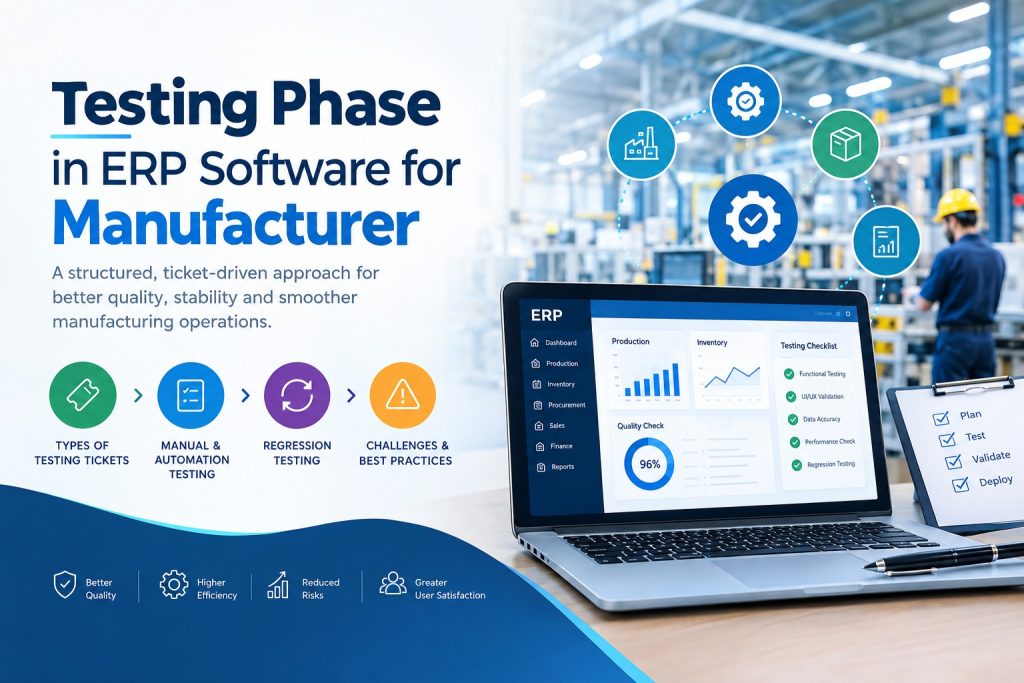
The testing phase ensures that every feature works as expected, data remains accurate, and business processes run smoothly. A structured testing approach helps manufacturers avoid operational disruptions, reduce errors, and improve user satisfaction.
Ticket-Driven Testing Approach
A ticket-driven testing process helps teams track requirements, changes, and testing activities efficiently. Every development task is assigned a ticket, which becomes the basis for validation and quality assurance.
This approach provides:
- Better requirement tracking
- Clear ownership of tasks
- Improved communication between teams
- Faster issue resolution
- Better software quality
For an ERP software for manufacturer, where multiple modules are interconnected, ticket-based testing helps maintain consistency and control throughout the development lifecycle.
Types of Testing Tickets
New Requirement
New requirement tickets introduce completely new features into the ERP system.
Examples include:
- Production planning modules
- Inventory management enhancements
- Vendor management features
- Quality control workflows
Testing focuses on validating business requirements, user workflows, and system integration.
Customization
Manufacturing companies often require ERP customizations to match their unique business processes.
Testing includes:
- Workflow validation
- Business logic verification
- Impact analysis
- Regression testing
New Report
Reports are critical for business decision-making.
Testing new reports involves:
- Data accuracy checks
- Filter validation
- Layout verification
- Export testing
Report Customization
When existing reports are modified, testing ensures:
- Correct calculations
- Accurate data display
- Proper formatting
- Improved usability
Ticket Lifecycle
Every ticket follows a structured workflow:
Development → Under QA → QA Completed → Ready for Deployment
This process ensures that each requirement is thoroughly tested before reaching end users.
Development
The development team implements the requested functionality and performs initial validation.
Under QA
The quality assurance team executes test cases, identifies issues, and validates fixes.
QA Completed
The ticket moves to this stage only after all testing activities are successfully completed.
Ready for Deployment
Once approved, the feature becomes ready for production deployment.
Manual Testing in ERP Software for Manufacturer
Manual testing remains an important part of ERP validation.
It helps testers evaluate:
- Business workflows
- User experience
- Functional requirements
- Real-world scenarios
Key manual testing activities include:
Functional Testing
Verifies whether features perform according to requirements.
UI Validation
Ensures the ERP interface is user-friendly and easy to navigate.
Exploratory Testing
Helps identify unexpected issues beyond predefined test cases.
Regression Testing
Validates that existing features continue to work after new changes are introduced.
Manual testing is especially valuable in ERP software for manufacturer because manufacturing processes often involve complex workflows that require human validation.
Automation Testing
Automation testing improves testing efficiency and consistency.
It is commonly used for:
- Repetitive test cases
- Regression testing
- Stable modules
- Frequently used workflows
Benefits of Automation Testing
- Faster execution
- Reduced manual effort
- Better test coverage
- Improved accuracy
- Early defect detection
By combining automation with manual testing, manufacturers can achieve better software quality while reducing testing time.
Regression Testing
Regression testing is one of the most critical activities in ERP testing.
Whenever a new feature or customization is introduced, existing functionality must be revalidated to ensure nothing has been affected.
Regression testing helps ensure:
- Stable business operations
- Accurate data processing
- Consistent user experience
- Reliable system performance
For any ERP software for manufacturer, regression testing protects critical areas such as inventory, production, procurement, sales, and finance.
Common Challenges in ERP Testing
Although a ticket-driven testing process provides structure, several challenges may arise.
Incomplete Requirements
Unclear requirements can lead to misunderstandings and additional rework.
Frequent Changes
Customization requests often change during development, increasing testing effort.
Module Dependencies
ERP modules are interconnected, making impact analysis essential.
Report Data Issues
Data mismatches and incorrect calculations can affect business decisions.
Addressing these challenges requires proper communication, documentation, and collaboration between teams.
Best Practices for Effective ERP Testing
To improve software quality, organizations should follow these best practices:
- Create detailed test cases for every ticket
- Perform impact analysis before testing
- Prioritize high-risk functionalities
- Automate repetitive test scenarios
- Conduct thorough regression testing
- Validate reports using real business data
- Maintain clear communication between teams
These practices help deliver reliable and scalable ERP software for manufacturer solutions.
Conclusion
Testing plays a vital role in delivering a reliable ERP software for manufacturer. A structured ticket-driven approach ensures that every requirement, customization, and report is thoroughly validated before deployment.
By combining manual testing, automation testing, and regression testing, organizations can improve software quality, reduce operational risks, and ensure smooth manufacturing processes. A strong testing strategy ultimately leads to better performance, higher user satisfaction, and long-term business success.