In manufacturing, producing the right product is only half the job. Getting the finished goods to the right customer, at the right time, and in the right quantity is equally important.
A missed shipment, incorrect quantity, or delayed delivery can affect customer satisfaction and disrupt the entire order-to-cash process. In many manufacturing companies, these issues are not caused by production problems but by a lack of proper dispatch planning.
This is where a Dispatch Plan in Manufacturing ERP can make a significant difference.
With Freedom ERP, the Dispatch Plan provides a structured way to schedule and manage deliveries before the goods leave the warehouse. It connects the Sales Order with the warehouse, transport, dispatch, and accounts teams through a single system.
What Is a Dispatch Plan in Manufacturing ERP?
A Dispatch Plan is a delivery schedule created against a confirmed Sales Order in an ERP system.
Manufacturing orders are often delivered in multiple batches rather than in a single shipment. Different quantities may need to be dispatched on different dates depending on:
- Production completion
- Stock availability
- Customer requirements
- Vehicle availability
- Delivery schedules
- Partial delivery commitments
Instead of managing these details through phone calls, spreadsheets, handwritten notes, or separate records, the Dispatch Plan brings everything together in one place.
The team can define the delivery date, quantity, vehicle details, and destination for each delivery batch.
Once the plan is approved, the warehouse and other concerned teams have a clear instruction to follow.
The Challenges of Manual Dispatch Planning
Without a structured dispatch process, manufacturing companies often depend on manual coordination.
For example, the sales team may call the warehouse to check whether the goods are ready. The store team then checks the stock manually, arranges transportation, prepares a delivery challan, and informs the accounts team about the dispatch.
This process may work for smaller operations, but as order volumes increase, the possibility of errors also increases.
Common challenges include:
- Incorrect dispatch quantities
- Delayed deliveries
- Missing or misplaced challans
- Difficulty tracking partial deliveries
- Stock records not being updated on time
- Invoice and dispatch mismatches
- Repeated coordination between departments
- Difficulty tracking the status of customer orders
A centralized Dispatch Plan helps eliminate much of this manual dependency.
How Dispatch Planning Works in Freedom ERP
The Dispatch Plan acts as a link between the Sales Order and the actual dispatch.
The typical workflow is:
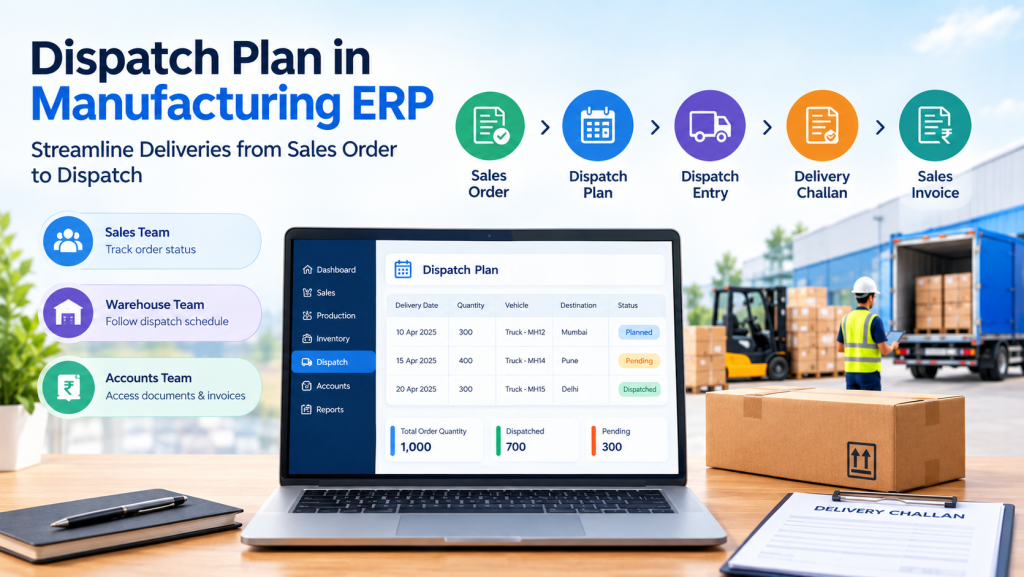
Sales Order → Dispatch Plan → Dispatch Entry → Delivery Challan → Sales Invoice
After a Sales Order is confirmed, the concerned team can create a Dispatch Plan against the order.
The team can then define the required delivery batches, quantities, delivery dates, and transportation details.
Once the plan is reviewed and approved, the warehouse team can proceed with the dispatch.
When the Dispatch Entry is created against the approved plan, the relevant inventory and documentation processes are connected through the system.
This helps ensure that the quantity dispatched, stock movement, delivery documentation, and invoicing remain aligned.
Managing Partial Deliveries Easily
Partial deliveries are common in manufacturing.
For example, a customer may place an order for 1,000 units, but the manufacturer may be able to dispatch:
- 300 units on the first delivery
- 400 units on the second delivery
- 300 units on the final delivery
Managing these deliveries manually can make it difficult to know what has already been dispatched and what is still pending.
With a Dispatch Plan, these delivery batches can be organized against the same Sales Order.
Teams can track:
- Total ordered quantity
- Quantity planned for dispatch
- Quantity already dispatched
- Pending quantity
- Delivery dates
- Vehicle details
- Delivery destination
This provides better visibility throughout the order lifecycle.
Connecting Sales, Warehouse, and Accounts
One of the biggest advantages of a Dispatch Plan is that different departments can work with the same information.
Sales Team
The sales team can track the status of customer deliveries without repeatedly calling the warehouse.
Instead of asking whether an order has been dispatched, the information can be checked from the system.
Warehouse Team
The warehouse team gets a clear dispatch schedule showing what needs to be dispatched, when it needs to be dispatched, and the required quantity.
This reduces dependency on verbal instructions and last-minute coordination.
Accounts Team
The accounts team can access dispatch-related information and documentation from the system, reducing the need to collect physical documents from different departments.
This makes reconciliation and order tracking easier.
What Happens When Dispatch Planning Is System-Driven?
When dispatch planning becomes part of the ERP workflow, the daily process becomes more structured.
The warehouse team can start the day by checking the planned dispatches in the system.
Instead of asking:
“What needs to go today?”
the team has a defined schedule to work from.
Instead of manually checking multiple records, the required order and dispatch information is available in one system.
This creates better coordination between sales, warehouse, logistics, and accounts.
Better Visibility into Delivery Status
Customer communication becomes easier when delivery information is available in the ERP.
The sales team can check whether a delivery is:
- Planned
- Pending
- Dispatched
- Partially completed
- Completed
This allows the team to provide customers with more accurate updates instead of depending on multiple phone calls and manual confirmations.
Flexibility When Delivery Plans Change
Manufacturing schedules do not always go according to the original plan.
Production may be delayed. A customer may request a different delivery date. Vehicle availability may change. Quantities may also need to be adjusted.
A structured Dispatch Plan allows teams to manage these changes within the system instead of creating an entirely new process every time.
Delivery batches can be adjusted based on operational requirements, helping teams maintain better control over changing delivery schedules.
Why Dispatch Planning Matters in Manufacturing
Dispatch is the final operational step before the finished product reaches the customer. A problem at this stage can affect the customer’s overall experience, even when production has been completed successfully.
A structured dispatch process helps businesses improve:
- Delivery planning
- Inventory visibility
- Order tracking
- Interdepartmental coordination
- Documentation
- Dispatch accuracy
- Customer communication
- Order-to-invoice traceability
The goal is simple: plan the delivery before the goods leave the warehouse.
Best Practice: Create the Dispatch Plan Before Packing
One of the most important practices for effective dispatch management is to create the Dispatch Plan before the goods are packed or moved.
This helps ensure that:
- The correct quantity is prepared
- The right order is selected
- Stock records remain accurate
- Delivery documentation is properly maintained
- The accounts team receives the required information
- The dispatch can be traced back to the Sales Order
A few minutes spent planning a delivery can prevent hours of follow-up later.
Streamline Dispatch Management with Freedom ERP
A manufacturing ERP should not only help businesses manage production. It should connect the complete workflow from Sales Order to final delivery.
Freedom ERP’s Dispatch Plan helps manufacturing teams organize delivery schedules, manage partial deliveries, coordinate warehouse activities, and maintain connected dispatch documentation within one system.
When sales, warehouse, logistics, and accounts teams work from the same data, dispatch becomes more predictable and easier to manage.
Plan the dispatch. Coordinate the teams. Deliver with confidence.
With a structured Dispatch Plan, manufacturing companies can move from last-minute coordination to a more organized and system-driven dispatch process.
Conclusion
A well-planned dispatch process helps manufacturing companies deliver the right products to the right customers on time. A Dispatch Plan in Manufacturing ERP brings sales, warehouse, logistics, and accounts teams together on one platform.
With Freedom ERP, businesses can plan dispatches, manage partial deliveries, track order status, and keep dispatch information connected with sales and invoicing.
Plan better. Dispatch faster. Deliver with confidence.