Introduction
Managing employees efficiently is one of the most important responsibilities of any growing organization. From recruiting the right talent and conducting structured interviews to managing employee records, handling approvals, and completing exit formalities, every stage of the employee journey requires accuracy, coordination, and accountability.
However, many organizations still depend on spreadsheets, emails, and disconnected HR tools to manage these activities. These traditional approaches often result in duplicate records, delayed approvals, documentation errors, and a lack of visibility across HR operations.
Modern businesses need more than basic HR administration. They need an integrated system that connects every employee-related activity.
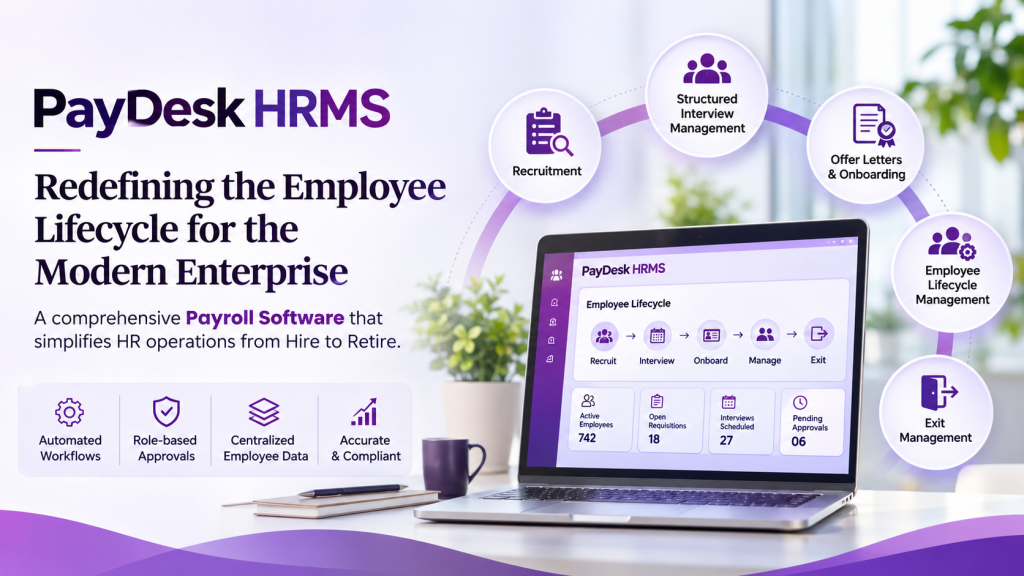
PayDesk HRMS 1.1 brings these processes together through a unified platform that automates administrative workflows, establishes structured approval hierarchies, and maintains employee information throughout the entire employment lifecycle.
By combining intelligent HR automation with the capabilities of modern payroll software, PayDesk helps organizations move towards a more organized, transparent, and efficient workforce management approach.
1. Streamlining Recruitment with Structured Workflows
Recruitment is the foundation of effective workforce management. Without a structured hiring process, organizations may experience unnecessary delays, inconsistent candidate information, and difficulties tracking recruitment progress.
PayDesk HRMS simplifies recruitment through a centralized and approval-driven process.
Manpower Requisition Management
Department heads can submit structured manpower requests by specifying the required position, seniority, business justification, and expected hiring timeline. Each request follows an HR approval workflow before recruitment activities begin.
This ensures that hiring decisions are aligned with actual workforce requirements.
Candidate Application Portal
Once a manpower requisition is approved, a branded candidate application portal can be generated. Applicants can submit their professional details, educational qualifications, employment history, references, and other required information through a structured online process.
This reduces manual data collection and ensures consistent candidate records.
Job Distribution and Application Approvals
Approved job requirements can be distributed through unique application links and QR codes, making it easier to reach potential candidates across different channels.
HR managers can review applications through dedicated approval queues, with mandatory remarks recorded at every decision stage.
Candidate Data Management
All candidate applications are maintained in a centralized repository. Duplicate detection using mobile numbers, email addresses, and Aadhaar identifiers helps prevent multiple records for the same applicant.
The result is a more reliable recruitment database and better control over hiring activities.
2. Structured Interview Management for Better Hiring Decisions
Recruitment does not end with receiving applications. Evaluating candidates through a consistent interview process is equally important.
PayDesk HRMS introduces a structured interview management system that helps organizations maintain transparency and consistency throughout candidate evaluation.
Interview Panel Configuration
Interview panels can be configured at the requisition level, assigning evaluators to Level 1, Level 2, and Final Panel interviews.
The system follows a sequential evaluation process, ensuring that candidates complete the preceding interview stage before moving to the next.
Interview Scheduling and Notifications
Interview schedules can be coordinated with automated notifications to candidates and panel members.
A centralized shortlist provides visibility into candidate progress across different interview stages, reducing manual coordination.
Structured Interview Evaluation
Each evaluator can record a formal decision, such as Selected, Rejected, or On Hold, supported by quantitative ratings and written remarks.
This creates a documented evaluation history that helps HR teams make informed hiring decisions.
3. Simplifying Offer Letters and Employee Onboarding
Once a candidate is selected, the next priority is ensuring a smooth transition from candidate to employee.
PayDesk HRMS simplifies this process through automated document generation and centralized employee information management.
Automated Offer Letter Generation
Offer letters can be generated for candidates with confirmed selection status. Candidate details are automatically populated, while salary structures can be applied using pre-approved templates.
Before dispatch, the offer letter follows an HR Manager approval process, ensuring accuracy and authorization.
Appointment Order Generation
Following offer acceptance, an official appointment order can be generated with a unique reference number.
Employee information is automatically retrieved from the Employee Master, reducing repetitive data entry and minimizing documentation errors.
Centralized Employee Master
PayDesk maintains a centralized employee profile containing important information such as:
- Personal and professional details
- Educational qualifications
- Previous employment history
- Certifications
- Statutory identification details
- Employee-related documents
This centralized repository makes employee information easier to retrieve and manage throughout the employment period.
4. Managing the Complete Employee Lifecycle
Effective HR management continues long after recruitment and onboarding. Organizations must monitor employee progress, manage confirmation processes, and handle exit formalities systematically.
PayDesk HRMS provides structured workflows for these important employee lifecycle activities.
Probation and Employee Confirmation
As an employee approaches the end of the probation period, the confirmation workflow can be initiated automatically.
The reporting manager submits a structured performance evaluation, following which HR reviews the assessment and decides whether to confirm the employee or extend the probation period.
All decisions are formally documented for future reference.
Relieving Letter Management
Relieving letters can be generated directly from the Employee Exit record based on the confirmed last working day.
If the exit date changes, the document can be revised accordingly. The finalized relieving letter can also be delivered through automated email, ensuring timely communication.
Service Certificate and Exit Clearance
PayDesk supports a structured exit clearance process involving IT, Finance, Administration, and HR departments.
Each department must complete its clearance responsibilities and mark the employee as ‘No Due’ before the service certificate becomes available.
This ensures that company assets, financial obligations, and departmental handover activities are properly addressed.
5. Workforce Tracking Through a Centralized Dashboard
Managing multiple HR activities becomes challenging when information is scattered across different systems.
PayDesk HRMS provides a centralized workforce tracking dashboard that offers visibility into important employee lifecycle activities.
HR teams can monitor:
- Active recruitment pipelines
- Pending approval requests
- Upcoming probation reviews
- Interview progress
- Employee onboarding activities
- Ongoing employee exits
This consolidated visibility helps HR managers identify pending activities, monitor progress, and take timely action.
6. PayDesk HRMS vs. Conventional HR Management
Traditional HR processes often depend on manual coordination, spreadsheets, and separate applications. PayDesk HRMS replaces these fragmented approaches with structured digital workflows.
| Conventional HR Practices | PayDesk HRMS 1.1 |
|---|---|
| Spreadsheet-based employee records with version conflicts | Centralized employee records with structured access |
| Email-based approvals that are difficult to track | Dedicated approval queues with mandatory remarks |
| Disconnected tools and fragmented information | Unified platform with connected employee data |
| Manual preparation of HR documents | Template-driven, auto-populated document generation |
| Duplicate candidate applications | Automated duplicate detection using key identifiers |
| Limited visibility into employee activities | Centralized workforce tracking dashboard |
By bringing these activities together, organizations can reduce repetitive administrative work and establish greater control over HR operations.
7. Why Integrated HRMS and Payroll Software Matter
HR management and payroll administration are closely connected. Employee information, attendance records, salary structures, statutory details, and employment status all contribute to accurate payroll processing.
Using integrated HRMS and payroll software helps organizations maintain better continuity between employee management and payroll-related activities.
With PayDesk, businesses can establish a structured approach to managing employee information and HR workflows while supporting their broader payroll management operations.
Instead of maintaining disconnected employee records and repeatedly entering the same information, organizations can work towards a more consistent and reliable workforce management environment.
Conclusion
Managing the complete employee lifecycle requires more than individual HR tools. It requires a connected platform that brings recruitment, interview management, onboarding, employee records, probation, and exit formalities into one organized system.
PayDesk HRMS 1.1 delivers this integrated approach by automating administrative workflows, strengthening approval accountability, and centralizing employee information.
Whether an organization is expanding its workforce, improving recruitment efficiency, or establishing more structured HR processes, PayDesk helps create a transparent and organized employee management environment.
Transform your HR operations with PayDesk HRMS 1.1. Contact our team today to schedule a product demonstration and discover a smarter approach to workforce management.