Introduction
In manufacturing, completing production on time is only half the job. Ensuring that finished goods reach the right customer, in the right quantity, at the right time is equally important. Yet, dispatch management is often one of the most overlooked areas in manufacturing operations.
A missed shipment, incorrect delivery quantity, or delayed dispatch can affect customer relationships, disrupt business operations, and create unnecessary confusion between departments. In many cases, the problem is not production itself but the lack of a structured delivery plan.
This is where an ERP (Enterprise Resource Planning) system plays an important role. With a dedicated Dispatch Plan module, manufacturing companies can bring their sales, warehouse, transport, and accounts teams together through a single, organised delivery process.
Understanding Dispatch Planning in Manufacturing
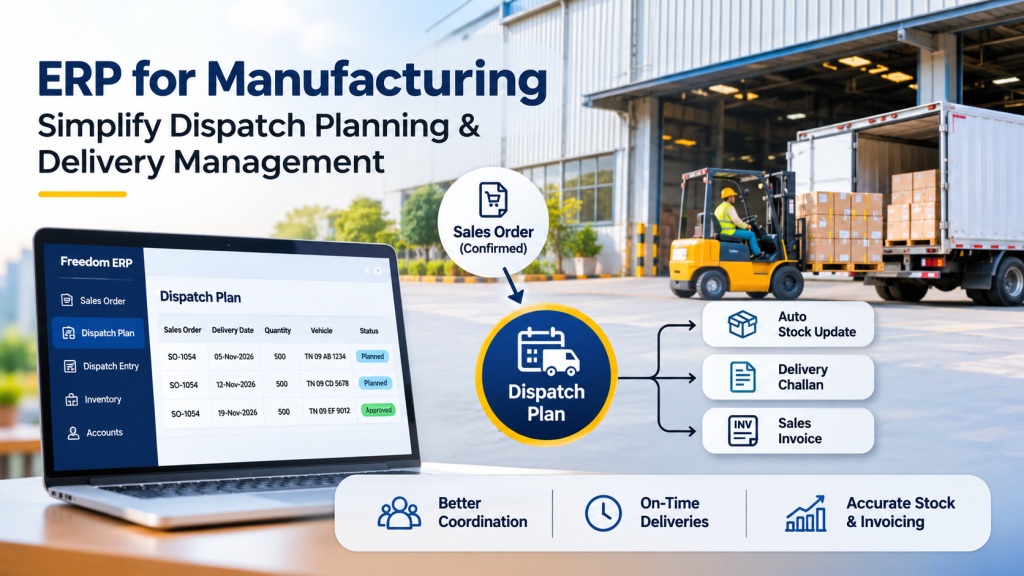
A Dispatch Plan is a delivery schedule created against a confirmed Sales Order. It helps manufacturing companies organise how and when finished goods will be delivered to customers.
For example, when a customer places a large order, the entire quantity may not be ready for dispatch at once. Deliveries may need to be split into multiple batches depending on production completion, stock availability, transport arrangements, and customer requirements.
A structured Dispatch Plan records all these details in one place, including:
- Customer and Sales Order details
- Planned delivery dates
- Batch-wise delivery quantities
- Vehicle and transport details
- Delivery destination
Instead of depending on phone calls, handwritten challans, or verbal instructions, every department works from the same confirmed delivery schedule.
Why Manufacturing Companies Need a Structured Dispatch Process
Without a proper dispatch management system, delivery operations often depend on manual coordination.
Consider a typical manufacturing unit. The sales team informs the store manager about an upcoming delivery. The store team checks stock manually, arranges transportation, prepares a handwritten challan, and coordinates with accounts for invoicing.
While this process may work for smaller operations, it becomes difficult to manage as order volumes increase.
Common challenges include:
- Incorrect dispatch quantities due to manual entries.
- Delays caused by poor coordination between departments.
- Difficulty tracking partial deliveries.
- Stock mismatches between physical inventory and system records.
- Delayed invoicing and reconciliation.
- Limited visibility into pending and completed deliveries.
A structured ERP-based dispatch process helps eliminate these gaps by connecting every delivery to its original Sales Order.
How ERP Connects Dispatch Planning with the Entire Workflow
A well-integrated ERP system connects dispatch planning with sales, inventory, and accounts, ensuring that every activity follows a defined process.
The workflow begins when a Sales Order is confirmed. The concerned team creates a Dispatch Plan, defines delivery batches, enters the required transport details, and submits the plan for approval.
Once approved, the warehouse team can raise a Dispatch Entry against the plan.
This process connects three important activities:
1. Automatic Stock Update
Once goods are dispatched, the inventory is automatically updated in the ERP system, ensuring that stock records reflect the actual movement of materials.
2. Delivery Challan Generation
A Delivery Challan is generated directly from the system, reducing manual documentation and ensuring accurate dispatch records.
3. Sales Invoice Generation
The dispatch process is connected to invoicing, helping the accounts team generate invoices based on actual dispatched quantities.
This integrated workflow ensures that stock, delivery documentation, and invoicing remain aligned throughout the process.
Managing Partial Deliveries and Changing Schedules
Manufacturing operations rarely follow a fixed schedule. Production delays, urgent customer requirements, and changes in transport availability can affect planned deliveries.
An effective Dispatch Plan should be flexible enough to accommodate these changes.
With an ERP-based approach, teams can:
- Reschedule planned delivery batches.
- Adjust delivery quantities based on stock availability.
- Add new delivery batches to an existing plan.
- Update transport details whenever required.
- Maintain a record of changes for future reference.
This flexibility allows manufacturing companies to manage changing delivery requirements without losing track of the original Sales Order.
What Changes When Dispatch Planning Becomes System-Driven?
The real value of a Dispatch Plan becomes visible in the day-to-day activities of different departments.
For the Warehouse Team
The warehouse team can start the day by reviewing the dispatch schedule in the ERP system. They know which orders need to be dispatched, the required quantities, and the corresponding vehicle details.
Delivery Challans can be generated directly from the system, reducing manual work and unnecessary coordination.
For the Sales Team
The sales team no longer needs to contact the warehouse repeatedly to check delivery status. They can refer to the ERP system to track planned and completed dispatches and provide timely updates to customers.
For the Accounts Team
Since dispatch information is connected to invoicing, the accounts team can access accurate delivery records without depending on handwritten challans or manual confirmations.
All three departments work with the same information, improving coordination and reducing operational delays.
Best Practices for Effective Dispatch Management
Implementing an ERP system is only one part of improving dispatch operations. Following a consistent process is equally important.
Manufacturing companies can improve dispatch efficiency by adopting a few simple practices:
- Create the Dispatch Plan before packing or moving goods.
- Review the daily dispatch schedule at the beginning of each working day.
- Verify quantities against the approved Sales Order.
- Ensure vehicle and transport details are updated correctly.
- Record every schedule or quantity change in the system.
- Complete dispatch entries immediately after goods leave the warehouse.
These practices help maintain accurate inventory, reliable documentation, and better control over delivery operations.
Simplify Dispatch Management with Freedom ERP
Managing deliveries should not depend on last-minute coordination or manual follow-ups. A structured dispatch process helps manufacturing companies maintain better control over their warehouse operations while keeping sales and accounts activities connected.
Freedom ERP’s Dispatch Plan module provides a systematic way to schedule deliveries, manage partial shipments, record transport details, and connect dispatch activities with inventory and invoicing.
By bringing the entire delivery workflow into one system, Freedom ERP helps manufacturing teams improve visibility, reduce manual coordination, and maintain better control over customer deliveries.
Because successful manufacturing is not just about producing the right product. It is also about delivering it right.