Job Shop ERP System: A Complete Guide for Custom Manufacturing
Manufacturing businesses that produce customized products face unique challenges in planning, scheduling, inventory management, and job costing. Unlike repetitive production environments, job shops handle varying customer requirements, making operational control more complex. A Job Shop ERP System helps manufacturers streamline these processes and improve overall productivity.
Whether you operate a CNC machining facility, fabrication shop, or custom manufacturing business, the right ERP solution can provide greater visibility, efficiency, and profitability.
What is a Job Shop ERP System?
A Job Shop ERP System is specialized enterprise software designed to manage the unique workflows of make-to-order and custom manufacturing businesses. It integrates production planning, inventory management, purchasing, quality control, customer orders, and accounting into a single platform.
By connecting departments and providing real-time information, ERP software enables manufacturers to manage jobs more effectively while reducing manual processes and operational delays.
Why Job Shops Need ERP Software
Many manufacturers still rely on spreadsheets and disconnected applications to manage production. As the number of jobs and customer requirements grows, this approach often leads to inefficiencies.
A modern Job Shop ERP System helps businesses:
-
Improve production visibility
-
Reduce scheduling conflicts
-
Track job costs accurately
-
Optimize inventory levels
-
Increase on-time deliveries
-
Improve customer satisfaction
These advantages allow manufacturers to remain competitive in a rapidly changing market.
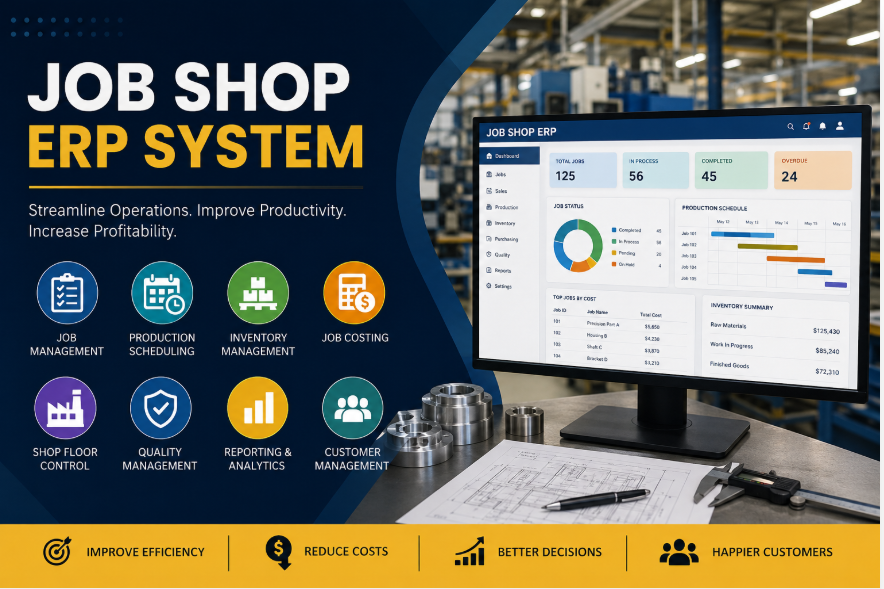
Key Features of a Job Shop ERP System
Production Planning and Scheduling
Advanced scheduling tools help managers allocate machines, labor, and materials efficiently. Real-time scheduling reduces bottlenecks and ensures jobs are completed on time.
Inventory Management
Inventory control is critical for custom manufacturing. ERP software tracks raw materials, work-in-progress inventory, and finished goods, reducing stock shortages and excess inventory.
For manufacturers seeking deeper insights into production workflows, explore this guide on ERP and Manufacturing.
Job Costing
Accurate job costing allows businesses to track labor, material, and overhead expenses associated with each project. This helps improve quoting accuracy and profitability.
Shop Floor Control
A Job Shop ERP System provides real-time updates from the shop floor, allowing managers to monitor job progress and identify potential delays before they impact delivery schedules.
Reporting and Analytics
Comprehensive reporting tools provide valuable insights into operational performance, helping management make informed decisions.
Benefits of Implementing ERP in Job Shops
Improved Operational Efficiency
Automation reduces manual data entry and administrative work. Employees spend less time managing paperwork and more time focusing on production activities.
Better Resource Utilization
ERP software enables manufacturers to maximize machine capacity and workforce productivity through improved planning.
Enhanced Decision-Making
Real-time information allows managers to respond quickly to changing production requirements and customer demands.
Reduced Costs
By optimizing inventory, labor utilization, and scheduling, businesses can lower operating expenses and improve margins.
Increased Customer Satisfaction
Customers benefit from accurate delivery dates, improved communication, and higher product quality.
For a detailed overview of measurable business benefits, read Benefits of ERP Manufacturing.
Industries That Benefit from ERP Solutions
ERP software is particularly valuable for:
-
CNC machining companies
-
Precision engineering firms
-
Tool and die manufacturers
-
Sheet metal fabrication businesses
-
Plastic injection molding companies
-
Aerospace component suppliers
-
Automotive parts manufacturers
These industries often require detailed production tracking, flexible scheduling, and precise job costing.
Common Challenges Solved by ERP
Production Delays
Manual scheduling frequently results in missed deadlines and bottlenecks. ERP software helps maintain efficient workflows.
Inventory Problems
A Job Shop ERP System provides accurate inventory visibility, reducing shortages and unnecessary stock accumulation.
Costing Errors
Without proper tracking, manufacturers may underquote projects. ERP systems ensure accurate cost calculations.
Lack of Visibility
Managers gain complete oversight of jobs, inventory, purchasing, and production activities through a centralized platform.
Choosing the Right ERP Solution
When evaluating ERP software, manufacturers should consider:
Industry-Specific Functionality
Look for solutions designed specifically for custom manufacturing and job shop operations.
Scalability
The software should support future growth without requiring significant system changes.
Integration Capabilities
ERP should integrate with CAD/CAM software, accounting systems, and shop floor equipment.
Ease of Use
User-friendly interfaces improve employee adoption and reduce training requirements.
Leading ERP Solutions for Manufacturers
Several ERP providers offer solutions tailored for custom manufacturing environments:
These platforms offer robust production planning, inventory management, job costing, and reporting capabilities.
The Future of ERP in Job Shop Manufacturing
The next generation of ERP systems is increasingly powered by cloud technology, artificial intelligence, machine learning, and Industrial IoT. These technologies provide predictive insights, automate routine tasks, and improve operational visibility.
Manufacturers adopting advanced ERP solutions can achieve greater efficiency, reduce downtime, and respond more effectively to customer demands.
Conclusion
A Job Shop ERP System provides manufacturers with the tools needed to manage production, inventory, scheduling, and costing from a single platform. By improving visibility and automating key processes, ERP software helps businesses increase productivity, reduce costs, and deliver superior customer service.
As manufacturing operations become more complex, investing in the right ERP solution is essential for sustainable growth and long-term success.