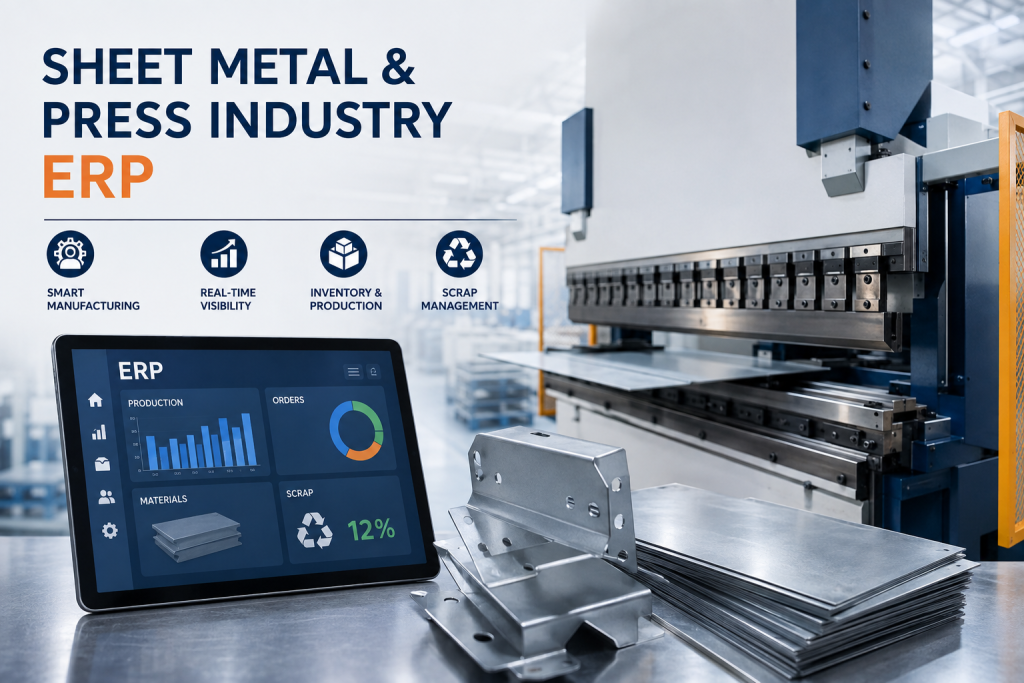
Sheet Metal & Press Industry ERP: Streamline Production, Inventory, Scrap & Shop-Floor Operations
The sheet metal and press industry operates in a highly competitive manufacturing environment where precision, productivity, material utilization, and timely delivery directly affect profitability. From raw material procurement and cutting to pressing, fabrication, quality inspection, and dispatch, manufacturers must coordinate multiple processes while keeping costs under control. A specialized Sheet Metal & Press Industry ERP can bring these activities together on a single platform, helping manufacturers improve visibility and make faster, data-driven decisions.
Unlike generic business software, an ERP designed for sheet metal and press operations can address industry-specific requirements such as material planning, production scheduling, press-shop management, scrap tracking, inventory control, job work, quality management, and costing. This makes ERP an important technology investment for manufacturers looking to scale efficiently.
What Is Sheet Metal & Press Industry ERP?
Sheet Metal & Press Industry ERP is an integrated enterprise resource planning solution designed to manage the complete manufacturing lifecycle of sheet metal fabrication and press-shop businesses.
It can connect departments such as:
Purchase and procurement
Production planning
Press shop
Sheet metal fabrication
Inventory and stores
Quality control
Tool and die management
Sales and order management
Scrap management
Finance and accounting
Dispatch and logistics
Instead of maintaining separate spreadsheets and disconnected software, manufacturers can manage operational information through a centralized ERP system. This provides better coordination between production, inventory, purchasing, sales, and finance teams.
Why Does the Sheet Metal Industry Need ERP?
Sheet metal manufacturing involves several variables, including material thickness, grades, dimensions, tooling requirements, machine capacity, production quantities, and customer-specific specifications. Even a small planning mistake can result in excess material consumption, production delays, or increased scrap.
An ERP system helps manufacturers create a structured workflow from sales order to production and final dispatch. Production teams can access planned quantities, material availability, machine requirements, and delivery schedules without depending entirely on manual communication.
For growing manufacturers, Sheet Metal & Press Industry ERP can also improve operational transparency by providing management with real-time information about inventory, orders, production status, costs, and pending activities.
Key Features of Sheet Metal & Press Industry ERP
A comprehensive ERP solution for sheet metal and press manufacturing can include several specialized modules.
1. Production Planning and Scheduling
Production scheduling is one of the most important functions in sheet metal manufacturing. Orders must be planned according to machine capacity, available raw materials, tooling, manpower, and delivery commitments.
ERP software can help planners create production schedules and monitor progress against planned quantities.
This connects directly with manufacturing production scheduling in ERP, where production requirements can be organized according to priorities, available resources, and customer deadlines.
2. Bill of Materials and Process Management
Different components may require different materials, operations, and processing sequences. ERP allows manufacturers to maintain Bills of Materials (BOMs) and manufacturing routes for individual products.
A typical process could include:
Raw Material → Cutting → Blanking → Pressing → Bending → Welding → Finishing → Inspection → Dispatch
The system can record the required material, operation sequence, machine, expected production time, and other relevant information.
3. Inventory and Material Management
Sheet metal manufacturers often handle various grades, thicknesses, sizes, coils, sheets, components, consumables, and finished goods.
ERP helps maintain accurate inventory records and provides visibility into:
Raw material stock
Work-in-progress
Finished goods
Consumables
Rejected material
Scrap
Minimum stock levels
Material receipts and issues
This reduces the risk of overstocking while ensuring critical materials are available when production begins.
Benefits of Metal Fabrication ERP Software
The benefits of metal fabrication ERP software extend beyond basic inventory and accounting. A properly implemented ERP system can connect the entire manufacturing process.
Better Production Visibility
Managers can monitor production orders, machine activities, pending quantities, completed quantities, and delays from a centralized system.
Improved Material Utilization
Material represents a significant portion of manufacturing costs. ERP can help track planned versus actual material consumption, making it easier to identify excessive consumption and opportunities to reduce waste.
Reduced Production Delays
Production planning becomes more systematic when orders, materials, machines, and delivery requirements are visible in one system.
Accurate Product Costing
ERP can combine material costs, labor, machine costs, overheads, and processing expenses to provide better visibility into product costs.
Better Inventory Control
Real-time inventory information helps purchasing teams make informed procurement decisions and reduces unnecessary stock accumulation.
Faster Decision-Making
Management can use reports and dashboards to identify production bottlenecks, slow-moving inventory, high scrap rates, and other operational issues.
Understanding Types of Manufacturing Wastes
Waste reduction is a major concern for sheet metal and press manufacturers. Understanding the types of manufacturing wastes can help organizations identify areas where ERP can improve efficiency.
Common manufacturing wastes include:
Material Waste – Excess sheet, rejected components, offcuts, and unusable remnants.
Overproduction – Manufacturing more products than currently required.
Waiting – Delays caused by unavailable materials, machines, tools, or approvals.
Transportation Waste – Unnecessary movement of raw materials or finished components.
Excess Processing – Performing unnecessary operations or repeated processing.
Inventory Waste – Holding more raw materials, components, or finished goods than required.
Defects – Rejected products, rework, and quality failures.
Underutilized Resources – Poor utilization of machines, employees, tools, or production capacity.
An ERP system can provide data that helps manufacturers identify these inefficiencies and take corrective action.
ERP for Sheet Metal Industry
ERP for Sheet Metal Industry is particularly useful for businesses handling customized fabrication, precision components, enclosures, brackets, panels, automobile parts, electrical components, and other sheet metal products.
The system can support material planning based on customer orders and production requirements. It can also help track different material grades and thicknesses throughout the manufacturing process.
For example, when a customer order is received, ERP can help determine:
Required raw material
Available stock
Material to be purchased
Production quantity
Required machines
Manufacturing operations
Expected completion date
Quality requirements
Dispatch schedule
This provides a connected workflow instead of managing each activity separately.
Press Shop ERP System
A Press Shop ERP System is designed to address the specific requirements of press-shop manufacturing, where operations may involve stamping, blanking, punching, forming, deep drawing, and other pressing processes.
Press-shop operations often depend on machine capacity, tooling availability, cycle time, die requirements, material specifications, and production quantities.
An ERP system can help track:
Press machines
Tool and die availability
Production orders
Machine capacity
Planned quantities
Actual production
Rejection quantities
Downtime
Tool maintenance
Production efficiency
By connecting press-shop activities with inventory and production planning, manufacturers can improve machine utilization and reduce scheduling conflicts.
Scrap Management ERP
Scrap is an unavoidable part of many sheet metal and press operations, but uncontrolled scrap can significantly affect profitability. A dedicated Scrap Management ERP module can help manufacturers record, classify, monitor, and analyze scrap generated during production.
Scrap can originate from:
Cutting and blanking
Punching
Pressing
Rejected components
Material defects
Setup activities
Production trials
Rework and quality rejection
ERP can record scrap quantities against production orders, materials, machines, or processes. Management can then compare actual scrap against expected or standard levels.
This information can help identify processes with unusually high material losses and support continuous improvement initiatives.
Manufacturing Costing and Profitability
Accurate costing is critical for sheet metal businesses because material prices, processing costs, labor, tooling expenses, and scrap can vary significantly between products.
A manufacturing ERP can help calculate costs using information from procurement, inventory, production, and finance.
Manufacturers can analyze:
Raw material cost
Processing cost
Labor cost
Machine cost
Tooling cost
Scrap value
Overhead
Total manufacturing cost
Expected margin
This enables businesses to prepare more accurate quotations and evaluate product profitability.
Quality Management and Rejection Tracking
Quality problems can result in customer complaints, rework, additional material consumption, and delivery delays. ERP can integrate quality checks into production workflows.
Inspection records can include dimensions, material specifications, process parameters, rejection quantities, and corrective actions.
When rejection data is connected with production information, management can identify recurring quality problems and determine which machines, materials, processes, or production orders are contributing to defects.
How ERP Improves Manufacturing Production Scheduling
Effective manufacturing production scheduling in ERP requires coordination between customer demand and available production resources.
ERP can help planners consider:
Customer delivery dates
Production quantities
Material availability
Machine capacity
Tool availability
Existing production orders
Process times
Employee availability
Maintenance schedules
Instead of relying solely on manual planning, manufacturers can use ERP data to develop more realistic production schedules.
This can reduce machine idle time, improve order fulfillment, and provide better visibility into expected completion dates.
Choosing the Right Sheet Metal & Press Industry ERP
Manufacturers should evaluate an ERP solution based on their actual operational requirements rather than selecting software only because it offers standard accounting or inventory features.
Important considerations include:
Sheet metal manufacturing support
Press-shop functionality
Production planning
BOM and routing
Material traceability
Scrap management
Tool and die management
Quality control
Inventory management
Job work management
Costing
Machine capacity planning
Reporting and dashboards
Scalability
Integration capabilities
The ERP should also be flexible enough to accommodate customized manufacturing processes and future business expansion.
Conclusion
Modern sheet metal and press manufacturers need more than basic accounting and inventory software. They require an integrated system capable of connecting production, material planning, press-shop operations, quality, costing, inventory, and scrap management.
A well-implemented Sheet Metal & Press Industry ERP can help manufacturers improve production visibility, optimize material utilization, reduce manufacturing waste, manage press-shop operations, and make better business decisions.
From ERP for Sheet Metal Industry operations to a dedicated Press Shop ERP System and Scrap Management ERP, an integrated solution provides manufacturers with the tools needed to build a more efficient and scalable manufacturing environment. As competition increases and customers demand better quality and faster deliveries, adopting industry-focused ERP can become a strategic advantage for sheet metal and press manufacturing businesses.